
Each year, the Harvard Joint Center for Housing Studies (JCHS) releases The State of the Nation’s Housing report, a research and data-driven analysis of housing across the country. This year’s rendition, The State of the Nation’s Housing 2026 (the Report), was published earlier this summer detailing a challenging national picture with a slowing housing market, rising household costs and a shortfall of available and affordable homes. Overall, this year’s report as well as related data reveal that economic, housing and other pressures are straining households across the country, with greater strain felt by lower income households.
Affordability Strains Impact Households in North Carolina and Across the Country
US residents are feeling the impacts of a housing affordability crisis. The Report details how residents are feeling this pressure through several metrics. Among homeowner households, about 23.9% or 20.7 million households are housing cost-burdened[i]—an increase of 4.0 million homeowner households since 2019. Moreover, approximately 9.6 million homeowner households are severely cost-burdened.[ii]
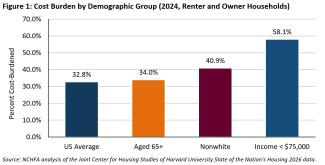
Renter households are facing cost burden at even higher rates than homeowners. The Report’s data show 49.4% of renter households are cost-burdened (about double the rate of homeowner cost burden) and 26.2% are severely cost-burdened. Cost burdens for both renter and owner households are not felt equally across the country. Rather, households that are lower income, elderly and homeowners of color experience cost burden at higher rates. See Figure 1 below.
North Carolina tracks similarly to the country in regards to cost burden trends. Across the state, the total cost burden rate is 30.3%. This figure is 21.2% for homeowner households and 48.8% for renter households. Similar to the country, renter households are also facing severe cost burden at a higher rate. Specifically, renter households in North Carolina are nearly 2.6 times as likely to be severely cost-burdened (25.3% compared to 9.8%). These figures are, at least in part, explained by rising rents. For North Carolina, median rents increased by 45.7% between 2019 and 2024 while incomes lagged significantly behind with median renter household income only rising 32.4%.
Incomes across the country are not keeping up with the rising costs of renting or owning a home, widening the already existing affordability gap. Consequently, in 2025, the ratio of median existing single family home price to median household income remained high at 4.7, up from 4.1 in 2019 and well above the low-3 range typical of the 1990s and early 2000s. The Report provides an interactive map of this ratio from 1980 through 2025. These higher prices translate directly into higher monthly mortgage payments for homeowners. In the last quarter of 2025, the estimated mortgage payment for a median-priced home was $2,420.[iii] This is nearly double the estimated mortgage payment for a median-priced home in 2020 of $1,240. These rising costs both burden current homeowners and create barriers for renters trying to enter home ownership. Only about 16% of renters earn enough to afford a median-priced home.
Beyond Housing Costs, Economic Pressures are Straining US Households
The Report also shows that not only are housing costs increasing, so are many related expenses including insurance premiums, energy bills and property taxes. From 2019 through 2025, property taxes rose by an average of 31% and home insurance premiums increased by 72%.
External debts are also straining US households. For example, the return of federal student loan repayments is impacting many residents. According to the Report, the 90-day delinquency rate for student loans increased more than ten-fold from late 2024 to late 2025, increasing from less than 1% to 10%.
These pressures, combined with slowing job growth and lack of confidence in the economy, are inhibiting housing demand. The Report describes that the country and its housing market are currently in a “low-hire, low-fire economy” with job growth at its lowest level for a non-recession year since 2002. More, consumer confidence in the economy was at a near record low, 29% lower in December 2025 than a year earlier and remaining low in 2026.
North Carolinians have experienced similar strains. According to US Census Bureau data, from 2019 through 2024, homeowners paying mortgages in North Carolina also saw a large increase in property taxes with the median property tax amount rising by 36.5%.[iv] State residents with student loans also are increasingly behind on making payments. The Federal Reserve Bank of New York reports that between 20% and 25% of North Carolinian student loan borrowers had past due balances in 2025.[v]
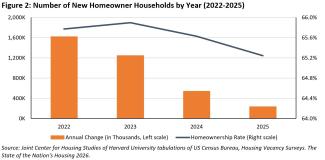
Altogether, these factors have shaped the current housing market, characterized by slowed household growth (i.e., a smaller increase year-over-year in the number of new households), record-low housing mobility and declining home ownership rates. North Carolina has experienced a similar decline, with homeownership rates falling from 68.7% in 2020 to 64.5% in 2025.[vi] Specifically, while the country still saw a modest increase in the number of homeowners (234,000) in 2025, this is the slowest growth in home ownership in a decade and is significantly lower than the increases seen over the previous three years. See Figure 2 below.
Where Can I Learn More?
The Report details more than can be contained in a single blog post, including discussion on vacancy rates, supply and demand dynamics, impacts of weather- and climate-related disasters and the context of recent federal and global events. The 48-page Report along with its supporting data, charts, sources and other resources can all be found on the Joint Center for Housing Studies’ Report Dashboard, available here.
More information about housing in North Carolina can be found on the Agency’s website including through the Housing Snapshot which provides statewide- and county-level data on demographics, housing affordability, housing supply and demand, and housing types and conditions.
The North Carolina Housing Finance Agency supports many programs helping provide quality affordable housing for current and future homeowners, renters and those experiencing or at risk of experiencing homelessness. Learn more about the Agency’s programs and other resources on its website.
-------------------
[i] A household is considered housing cost burdened if it is spending 30% or more of gross income on housing costs.
[ii] A household is considered severely cost burdened if it is spending 50% or more of gross income on housing costs.
[iii] This estimate assumes a 3.5% down payment, 30-year fixed-rate mortgage and an interest rate of 6%.
[iv] NCHFA analysis of US Census Bureau, American Community Survey 1-Year Estimates, Table B25103.
[v] Haughwout, A., et al. Federal Reserve Bank of New York. “Student Loan Delinquencies Are Back, and Credit Scores Take a Tumble.” May 13, 2025. Available here.
[vi] NCHFA analysis of US Census Bureau, Housing Vacancies and Homeownership Annual Statistics, Table 15.