
Home buying in North Carolina is becoming increasingly unaffordable, and Community Land Trusts (CLTs) are one tool that helps make home ownership more achievable for residents. In December of 2024, the median sales price for a single-family home in North Carolina reached $388,000, up from $255,000 in December 2019, a 52.5% increase over five years.[i] In that same five-year period, monthly median housing costs[ii] for homeowners increased by 34.6%.[iii] While many affordable housing programs aim to help residents access safe and affordable homes, most of these programs provide assistance for a limited amount of time. CLTs stand out as one of few strategies that can provide affordable housing for the long-term.
The Community Land Trust Model
At its core, a Community Land Trust provides opportunities for home buyers to purchase a home while leasing the land it sits on. While the specific details of a CLT can change from place to place and from organization to organization, the typical CLT model starts with a nonprofit organization acquiring and keeping land for the benefit of the community. The CLT then can sell the homes that sit on that land while leasing the land itself to new homeowners. This “ground lease” can take several forms, but the standard ground lease is a long-term (often 99-year term in North Carolina) renewable lease that includes a resale price restriction, and sometimes includes a right of first refusal for the CLT. See Figure 1 below for a quick overview of the CLT model process.
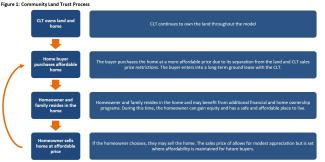
This model improves affordability mainly through two methods: (1) it removes the cost of the land from the home purchase price and (2) it limits resale prices to keep the home affordable long-term. Resale limits vary across CLTs, but are typically defined by a formula written into the ground lease or similar legal document. This approach allows the current owner to realize a modest amount of appreciation while keeping the home price affordable for future buyers.
Some examples of common approaches include allowing the sales price to increase by a fixed percentage each year, increase according to an inflation index such as the consumer price index or to increase by a fixed amount each year. Many CLTs offer a more complex formula that may mix some of these methods or otherwise provide more nuance. And, because of its renewing 99-year lease term, the CLT model’s affordability can last.
Other Community Land Trust Benefits
While the chief benefit of CLTs is the affordability found through the inherent CLT model, they also offer many other benefits to residents and the community, including:
- Stewardship: Many CLTs offer “stewardship” or similar programs that help protect residents against sudden housing expenses such as HVAC, water heater or roof repair or replacement. Often, these programs have reserves of money set aside that provide financial assistance to homeowners within the CLT for critical and costly repairs and replacements.
- Counseling and education: CLTs often provide applicants and residents with access to home buyer education, financial literacy and planning and credit counseling courses among other learning opportunities.
- Wealth building: Not only does the CLT model ensure affordability for current and future home buyers, but it also allows those within the community to build generational wealth. Homeowners are afforded the opportunity to build equity in their home over time as well as realize modest appreciation upon resale.
- Community engagement and governance: CLTs are typically governed by a board that includes community residents and advocates. This structure ensures that CLTs are governed both day-to-day and for the long term in a manner that incorporates community engagement and the best interests of the residents.
CLTs and North Carolina:
North Carolina has many CLT programs within the state and, as of 2025, also has a statewide CLT coalition. CLTs can be found across the state in both metro and rural areas. The North Carolina Community Land Trust Coalition recently started with its first in-person meeting in April 2025. The coalition has 11 member CLT programs which, in turn, report assisting over 550 households with an average income of about 63% of the area median income.[iv]
Through prospective CLT home purchasers participating in Agency home buying programs, Community Land Trusts pair well with the North Carolina Housing Finance Agency’s affordable mortgage products. CLTs help enable lower income residents to buy affordable homes and the Agency’s home buyer programs also increase affordability and access for North Carolinian through down payment assistance, competitive interest rates, minimum credit score requirements and home buyer education. The Agency’s programs include the NC Home Advantage Mortgage™ which provides qualified buyers with a 0% interest, forgivable loan of up to 3% of their mortgage loan amount for their down payment and the NC 1st Home Advantage Down Payment provides $15,000 in down payment assistance, also as a 0% forgivable loan, for qualifying first-time buyers and military veterans.
Additional information about these programs and more can be found in NC Housing Finance Agency’s Affordable Housing is Our Business and on the Agency’s website, www.nchfa.com.
---------
[i] Redfin monthly housing market data, 2016-2025. Data accessed July 28, 2025. To see more information on housing availability including how median sales prices have changed over the last nine years, see the Agency’s Housing Snapshot.
[ii] Homeowner costs include mortgages or similar debts on the property (e.g., home equity loans, secondary or junior mortgages); property taxes; insurance; utilities and fuels. It also includes, if applicable, the monthly homeowner’s association fee, condominium fee, or mobile home costs (e.g., personal property taxes, site rent, registration fees, and license fees).
[iii] NCHFA analysis of US Census Bureau, American Community Survey 1-Year Estimates, Table B25088.
[iv] Sanchez, K. North Carolina Community Land Trust Coalition. (2025). Link